
Quick Answer
The I-601A provisional unlawful presence waiver lets certain immigrants forgive their unlawful presence before leaving the United States for a green card interview abroad, so the 3-year or 10-year reentry bar never separates the family. To qualify, you must be at least 17, physically present in the U.S. with a pending immigrant visa case and prove that a U.S. citizen or lawful permanent resident spouse or parent would suffer extreme hardship without you. The filing fee is $795, and USCIS processing is averaging roughly 2 to 2.5 years in 2026.
Summary
- What it forgives: unlawful presence only, the 3-year and 10-year bars under INA 212(a)(9)(B)
- Who it protects: applicants who must consular process abroad, typically after entry without inspection
- Qualifying relative: a U.S. citizen or green card holder spouse or parent. A U.S. citizen child does not qualify
- Legal standard: extreme hardship to the qualifying relative, more than normal family separation
- Filing fee: $795 to USCIS, after the State Department immigrant visa fee is paid
- Processing time: roughly 26 to 30 months on average in 2026
- Key protection: you remain in the U.S. with your family while USCIS decides
Introduction
For hundreds of thousands of mixed-status families, one legal trap stands between them and a green card: leaving the country for the required consular interview would trigger a 10-year bar to return. The I-601A provisional waiver exists to defuse that trap. Filed and decided while the applicant is still in the United States, it turns a potentially decade-long separation into a short trip abroad.
It is also one of the most technical and unforgiving filings in family immigration, and the stakes of getting it wrong rose again with 2026’s enforcement climate. This guide explains how the waiver works, who qualifies, what extreme hardship really means, current timelines and costs, and how strong cases are built.
What Is the I-601A Waiver?
The I-601A waiver, formally the Application for Provisional Unlawful Presence Waiver, is a USCIS filing that forgives an applicant’s unlawful presence in the United States before they depart for an immigrant visa interview abroad. “Provisional” is the key word: the waiver is approved in advance, while the applicant remains in the U.S., so that when they attend their green card interview at a U.S. consulate, the 3-year or 10-year unlawful presence bar does not apply. Without the waiver, that bar would activate the moment they left the country.
The I-601A covers one ground of inadmissibility only: unlawful presence. It does not forgive criminal grounds, fraud or misrepresentation, prior removals, or the permanent bar. Applicants with any of those issues need a different analysis, and often a different waiver.
The Problem It Solves: The 3-Year and 10-Year Unlawful Presence Bars
Under INA 212(a)(9)(B), a person who accrues more than 180 days of unlawful presence and then departs the United States is barred from returning for 3 years. More than one year of unlawful presence triggers a 10-year bar. The bars activate on departure, which creates the catch-22 the I-601A solves: many immigrants, especially those who entered without inspection, cannot get a green card inside the U.S. and must interview abroad, but leaving to attend that interview triggers the bar.
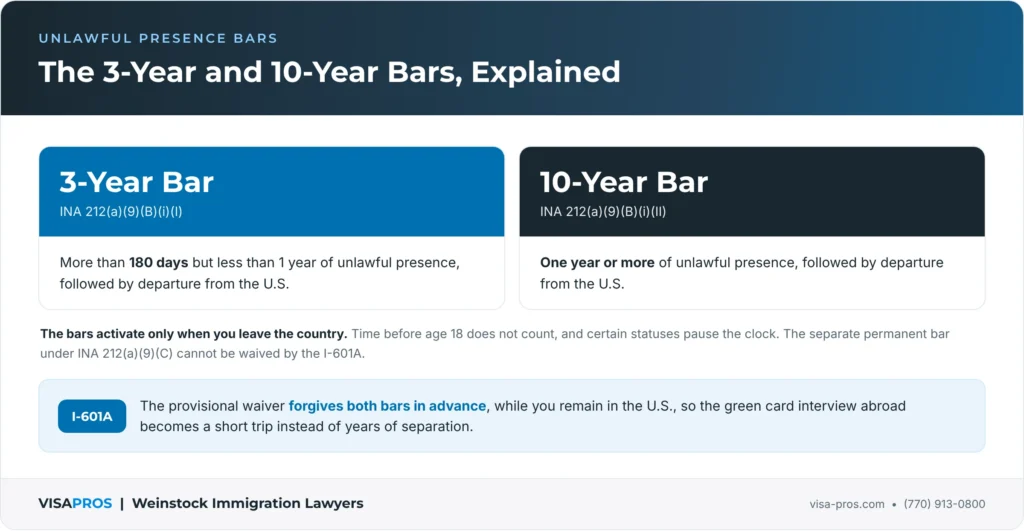
In text form: more than 180 days but less than one year of unlawful presence triggers a 3-year bar on departure. One year or more triggers a 10-year bar. Time counts only after the age of 18, and certain statuses pause the clock. The I-601A forgives these two bars in advance, before departure ever happens.
A critical distinction: a person who accrued more than one year of unlawful presence, left, and then returned or attempted to return illegally may face the permanent bar under INA 212(a)(9)(C). The I-601A cannot waive the permanent bar, and filing without spotting this issue can strand an applicant abroad. This single distinction is why experienced case screening matters more for I-601A than for almost any other filing.
Who Qualifies for the I-601A Waiver?
To qualify for the I-601A waiver, you must be at least 17 years old, physically present in the United States, have an immigrant visa case in process with the State Department fee paid, be inadmissible only for unlawful presence, and prove extreme hardship to a U.S. citizen or lawful permanent resident spouse or parent.

The requirements
- Age and presence: at least 17 years old and physically present in the U.S. when filing
- A pending immigrant visa case: typically an approved Form I-130 petition, with the Department of State immigrant visa processing fee paid; the fee receipt is a required exhibit
- Inadmissible only for unlawful presence: no criminal, fraud, prior removal, or other grounds in play
- A qualifying relative: a U.S. citizen or lawful permanent resident spouse or parent who would suffer extreme hardship
- No disqualifying history: applicants in active removal proceedings generally must have their case administratively closed or dismissed, and a prior removal order or a permanent bar problem requires separate analysis before any filing
Who does not qualify
Three surprises catch families most often. First, children do not count: hardship to a U.S. citizen child, no matter how severe, does not satisfy the statute, although a child’s circumstances can feed into a parent’s or spouse’s hardship case. Second, the sponsoring relative and the qualifying relative need not be the same person, but there must be a qualifying spouse or parent; an applicant sponsored by a U.S. citizen sibling with no citizen or resident spouse or parent has no waiver path here. Third, anyone with a possible permanent bar, prior removal, or criminal issue is not automatically out, but must resolve that analysis first, because the I-601A cannot fix those grounds.
What Counts as Extreme Hardship?
Extreme hardship means hardship beyond the normal consequences of family separation. Courts and USCIS recognize that separation always causes hardship; the waiver requires showing that this family’s situation is meaningfully worse, considering both scenarios: the qualifying relative remaining in the U.S. alone, and the qualifying relative relocating abroad.
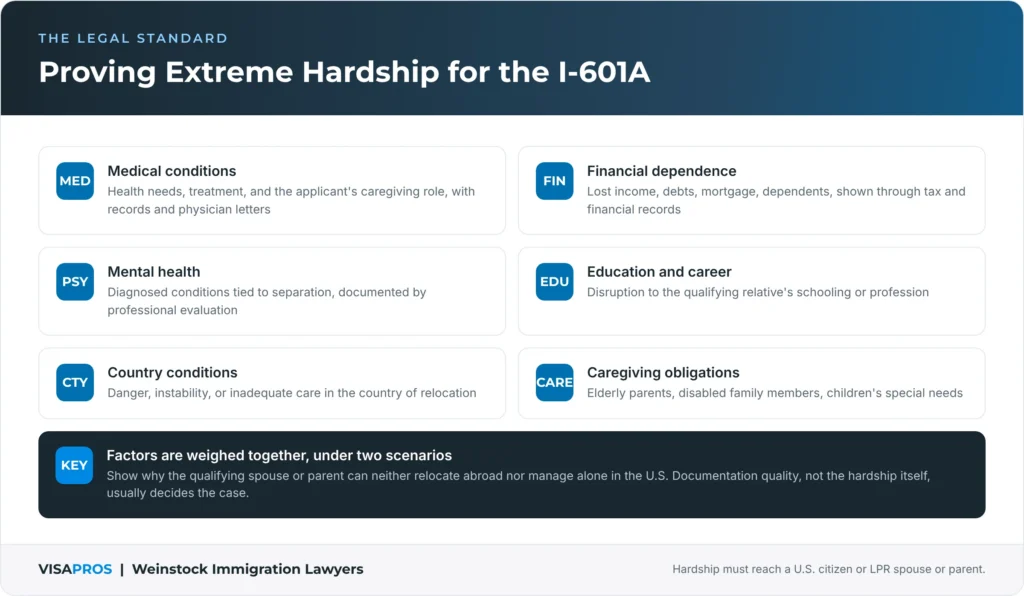
The strongest cases document hardship across several categories:
- Medical: the qualifying relative’s health conditions, treatment needs, and the applicant’s caregiving role, supported by medical records and physician letters
- Financial: loss of the applicant’s income, the relative’s debts, mortgages, and dependents, with tax returns and financial records
- Mental health: documented anxiety, depression, or other conditions tied to the potential separation, ideally through a professional evaluation
- Country conditions: danger, instability, or inadequate medical care in the country where the family would relocate, supported by State Department and country-conditions evidence
- Educational and career disruption for the qualifying relative
- Caregiving obligations: elderly parents, disabled family members, and children’s special needs that the qualifying relative could not manage alone
USCIS weighs hardship factors cumulatively. No single factor is required, and no single factor guarantees approval. The difference between approval and denial is usually not the family’s actual hardship but how thoroughly it is documented.
The I-601A Process Step by Step
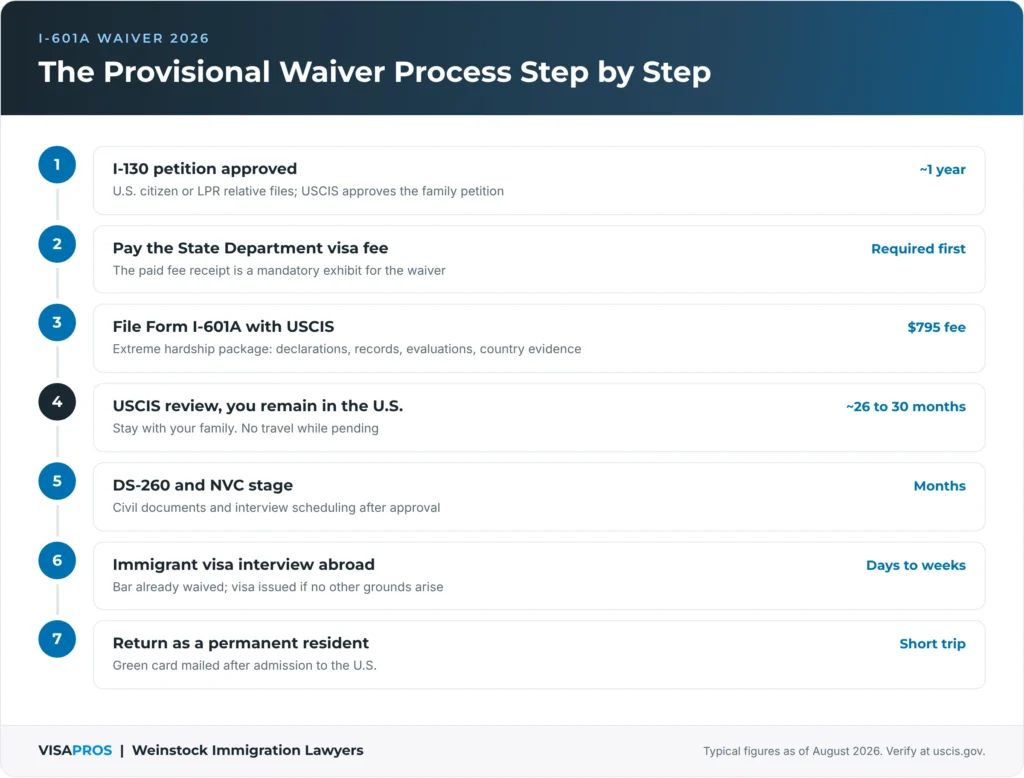
- Secure the immigrant visa petition. A qualifying family member (most often a U.S. citizen spouse) files Form I-130, and USCIS approves it.
- Pay the State Department immigrant visa fee. The case moves to the National Visa Center, and the immigrant visa processing fee must show as paid; the receipt goes into the waiver filing.
- File Form I-601A with USCIS. The filing includes the $795 fee and, most importantly, the extreme hardship evidence package: declarations, medical and financial records, evaluations, and country-conditions of documentation. Biometrics follow.
- Wait while remaining in the U.S. Processing is averaging roughly 26 to 30 months in 2026. The applicant stays with their family during this period.
- After approval, complete consular processing. The applicant submits the DS-260, assembles civil documents, and the NVC schedules the immigrant visa interview at the designated consulate, for Mexican nationals typically Ciudad Juárez.
- Attend the interview abroad. With the waiver already approved, the unlawful presence of bar does not apply. If no other inadmissibility issues arise, the consulate issues the immigrant visa, usually within days to weeks.
- Return to the U.S. as a lawful permanent resident. The trip abroad typically lasts a matter of weeks rather than years.
How Long Does the I-601A Waiver Take in 2026?
USCIS is taking roughly 26 to 30 months on average to decide I-601A waivers in 2026, based on recently reported processing data. Adding the I-130 petition stage before it (roughly a year) and consular scheduling after approval, families should realistically plan on a 3.5-to-4.5-year journey from first filing to green card, while living together in the U.S. throughout.
Two timeline notes: first, USCIS processing times shift; check the current I-601A figure on the USCIS Processing Times tool before planning any number. Second, cases far outside posted averages have options, including status inquiries and, in extreme situations, federal delay litigation.
How Much Does the I-601A Waiver Cost?
The I-601A filing fee is $795 as of August 2026. The full waiver journey also involves the I-130 petition fee ($675), the State Department immigrant visa fee ($325) which must be paid before the waiver is filed, the Affidavit of Support review fee ($120), the USCIS Immigrant Fee ($235) after visa approval, the medical exam abroad, and travel costs for the interview trip. Government costs across the whole process total roughly $2,150 plus the exam and travel.
Attorney fees for waiver cases typically run in the $3,000 to $8,000 range nationally, reflecting the evidence-heavy hardship package at the center of the case. Verify all government fees on the USCIS Fee Schedule (G-1055) before filing.
Filing in 2026: Risks and Realities
An honest discussion of the I-601A must include its risks, and 2026’s enforcement environment sharpens them:
- Filing identifies you to the government. The application discloses the applicant’s address and unlawful status. Historically, a pending waiver has not been an enforcement priority, but policies shift, and applicants with any criminal history or prior removal contact face genuinely different risk calculations. This is a conversation to have with a lawyer, honestly, and before filing.
- Approval is not a status. A pending or approved I-601A grants no work permit, no travel permission, and no protection from removal. The applicant’s day-to-day situation does not change until the green card is issued.
- The consulate can still find other problems. The waiver covers unlawful presence only. If the consular officer finds misrepresentation, criminal grounds, or a permanent bar issue, the applicant is stuck outside the U.S., and the approved I-601A does not help. Thorough pre-filing screening exists precisely to prevent this outcome.
- Do not travel while the case is pending. Departure before approval triggers the very bar the waiver exists to prevent.
None of these risks mean the waiver is a bad idea; for eligible families it is often the only realistic path. They mean the case deserves complete legal screening before the first form is filed.
What Happens If the I-601A Is Approved (and at the Interview Abroad)
Approval means USCIS has forgiven the unlawful presence of bars in advance. The case proceeds to the National Visa Center and then to the immigrant visa interview abroad. For most applicants with clean screenings, the interview is brief, the visa is issued within days to weeks, and they return home to the U.S. as permanent residents.
The approved waiver takes effect only when the applicant departs and attends the interview for the specific case it was filed under. Significant changes, such as a different petition or category, can require a new waiver, so keep counsel informed of any life changes between approval and travel.
What Happens If the I-601A Is Denied
A denial cannot be appealed, but it is not the end of the road. The applicant simply remains in the U.S. in the same position as before filing; the denial itself does not trigger removal proceedings in most cases, although the enforcement climate makes individualized advice essential. Options after denial include refiling with a stronger hardship package, which many families do successfully after addressing the gaps USCIS identified, or, where facts have changed, pursuing a different strategy entirely.
What a family should not do is proceed abroad without a waiver, because departure activates the bar, and the only remaining option becomes the standard I-601 waiver filed from outside the U.S., with the family separated while it is decided.
Approval Strategy: How Strong Cases Are Built
Across successful waiver cases, the same elements recur:
- Ruthless pre-screening. Every arrest, every entry and exit, every prior application is verified before filing, because the waiver only works if unlawful presence is truly the only problem.
- Hardship documented like a case file, not a letter. Strong filings pair the qualifying relative’s declaration with medical records, psychological evaluations, financial documents, school records, and country-conditions evidence, organized around both the stay-alone and relocate-abroad scenarios.
- Both scenarios argued. USCIS expects to see why the qualifying relative cannot simply relocate and why they cannot manage alone in the U.S. Cases that argue only one side leave the decision to the officer’s imagination.
- Professional evaluations are used well. A psychological evaluation that documents a diagnosed condition carries weight that a general statement of sadness does not.
- Consistency across the whole record. The waiver, the I-130, the DS-260, and decades-old filings are compared. Discrepancies invite denial and worse.
Next Steps
The I-601A waiver exists so that families like yours do not have to choose between a green card and a decade apart. It works, and it is worth doing well: the difference between an approval and a denial is usually preparation, and the difference between a safe filing and a dangerous one is the screening that happens before anything is filed.
The immigration attorneys at Visa Pros (Weinstock Immigration Lawyers) have prepared waivers of inadmissibility for families across Georgia, Alabama, and nationwide, including complex cases involving prior contacts with immigration enforcement. If you or your spouse may need an I-601A waiver, start with a confidential consultation, before filing anything, so the path you start is one you can safely finish.
This article provides general information about U.S. immigration law and is not legal advice. Waiver cases are highly fact-specific, and errors can have severe consequences; consult a qualified immigration attorney about your specific circumstances before filing. Fees and processing times change; verify current figures with USCIS.
Frequently Asked Questions
It is advance forgiveness for unlawful presence. Normally, leaving the U.S. for a green card interview abroad triggers a 3-year or 10-year bar to returning. The I-601A waives that bar before you leave, so the trip abroad becomes a matter of weeks instead of years.
You must be at least 17, physically present in the U.S., have an immigrant visa case in process with the State Department fee paid, be inadmissible only for unlawful presence, and prove extreme hardship to a U.S. citizen or lawful permanent resident spouse or parent.
No. Only a U.S. citizen or lawful permanent resident spouse or parent qualifies. Hardship to children can strengthen the case indirectly, through its effect on the qualifying spouse or parent, but a child alone does not satisfy the requirement.
USCIS is averaging roughly 26 to 30 months for I-601A decisions in 2026. The full journey, from I-130 filing through the interview abroad, realistically takes 3.5 to 4.5 years. Check the USCIS Processing Times tool for current figures.
The USCIS filing fee is $795 as of August 2026. Across the full process, government fees total roughly $2,150 including the I-130, State Department fees, and the USCIS Immigrant Fee, plus the medical exam and travel. Attorney fees for waiver cases typically run $3,000 to $8,000 nationally.
Hardship beyond the ordinary consequences of family separation, shown through factors like the qualifying relative’s medical conditions, financial dependence, mental health, caregiving obligations, and conditions in the country of relocation. USCIS weighs all factors together, under both the separation and relocation scenarios.
Yes. That is the waiver’s core benefit: you remain in the U.S. with your family during the entire USCIS review. But the pending waiver grants no work permit, no travel permission, and no legal status by itself.
No. The waiver is not a status and confers no work authorization or travel document. Traveling abroad before your immigrant visa interview would trigger the bar the waiver was meant to prevent. Work authorization comes only with the green card at the end of the process.
There is no appeal, but you remain in the U.S. in the same position as before filing, and refiling with stronger hardship evidence is permitted and often successful. What you should not do is depart for a consular interview without an approved waiver, because leaving activates the reentry bar.
The I-601A is filed from inside the U.S., before departure, and covers only unlawful presence. The I-601 is the standard waiver, generally filed from outside the U.S. after a consular officer finds inadmissibility, and it can cover additional grounds such as certain misrepresentation and criminal issues. Families use the I-601A precisely to avoid the separation an I-601 case involves.
For applicants with clean histories, filing has historically carried low enforcement risk, but the application does identify you to the government, and 2026’s enforcement climate makes individualized advice essential, especially for anyone with an arrest, a prior removal order, or past immigration contact. Discuss your full history with an attorney before filing.
No. The permanent bar under INA 212(a)(9)(C), which can apply after illegal reentry following a year of unlawful presence or removal, cannot be waived by the I-601A. Anyone with possible permanent bar facts needs careful legal analysis before filing anything.
Ready to Resolve Your Immigration Issue?
Whether it’s a work visa, green card, citizenship, or deportation defense, our Atlanta immigration attorneys are ready to help you find the best path forward.