

Quick Answer
Most immigration lawyers in 2026 charge flat fees that typically range from about $1,000 to $2,500 for naturalization, $2,500 to $5,000 for a family-based green card, $4,000 to $10,000 for asylum, and $4,000 to $15,000 or more for deportation defense, based on industry-reported national ranges. Hourly rates, where used, generally run $150 to $500. Government filing fees are always separate. Exact pricing depends on your case’s complexity, so a consultation is the only way to get a real number.
Summary
- Most common billing model: flat fees, so you know the full price before work begins
- Typical consultation: free to about $300, and many firms credit the fee toward your case
- Government filing fees are separate and go to USCIS or the State Department, not the lawyer
- Employment cases: by law, employers must pay PERM costs and required H-1B fees, not the employee
- Free help exists nonprofit legal aid, DOJ-accredited representatives, and the EOIR pro bono list
- Biggest pricing red flag guarantees approval. No honest lawyer can promise a result
Introduction
Price is the first question almost everyone asks before hiring an immigration lawyer, and it is also the question most law firm websites refuse to answer. This guide gives you realistic 2026 numbers: typical fee ranges by case type, how billing models work, what a quoted fee should include, and how to tell a fair price from an inflated or dishonestly cheap one.
One honest caveat up front: the ranges below are industry-reported national estimates, not any firm’s price list. Fees vary with the facts of your case, your location, and the experience of the attorney. Treat them as a sanity check for quotes, not a menu.
How Much Does an Immigration Lawyer Cost in 2026?
Immigration lawyer fees in 2026 typically fall between $1,000 and $15,000 depending on the type of case, with most routine family and citizenship matters at the lower end and court defense and complex waivers at the upper end.
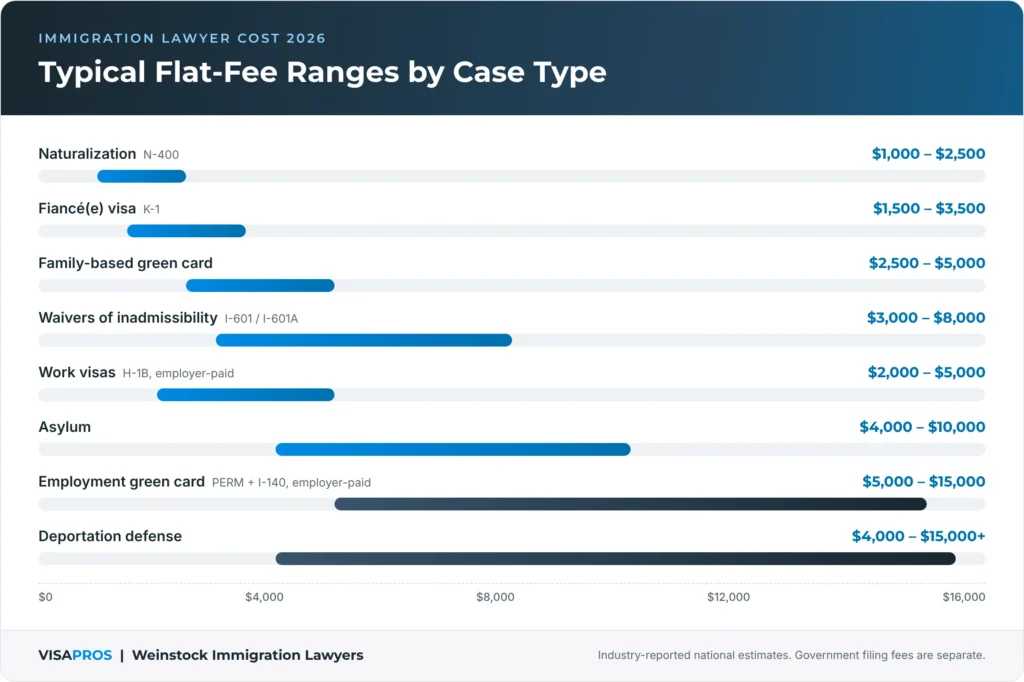
Typical industry-reported attorney fee ranges in 2026, excluding government filing fees:
- Naturalization (N-400): about $1,000 to $2,500 for most applicants, more when criminal history, long absences, or tax issues add risk
- Family-based green card (marriage or relative): about $2,500 to $5,000 for adjustment of status or consular processing
- Fiancé(e) visa (K-1): about $1,500 to $3,500
- Employment-based green card (PERM + I-140): about $5,000 to $15,000, paid by the employer
- H-1B and other work visas: about $2,000 to $5,000 for standard petitions, paid by the employer
- Asylum: about $4,000 to $10,000, reflecting the heavy evidence and declaration work involved
- Waivers of inadmissibility (I-601/I-601A): about $3,000 to $8,000
- Deportation defense: about $4,000 to $15,000 or more, depending on relief sought and how long proceedings run
- Appeals (BIA, federal court): frequently $5,000 and up
Consultations typically run from free to about $300. Many firms, including Visa Pros, offer a free case evaluation, and many that charge will credit the consultation fee toward your case if you hire them.
Why Immigration Lawyer Fees Vary So Much
Two people with “the same” case type can be quoted very different fees for legitimate reasons:
- Complexity and risk. A marriage green card with a clean immigration history is a different project than one involving a prior overstay, a criminal record, or a previous denial. Complications multiply attorney hours.
- Scope of work. Some quotes cover only form preparation. Others include strategy, evidence development, RFE responses, and interview preparation. A cheaper quote often covers less.
- Experience and results. Attorneys with decades of experience and strong track records in a niche price accordingly, and they often prevent expensive problems a cheaper preparer would miss.
- Location and overhead. Major-metro firms tend to charge more than smaller-market firms, though remote representation has narrowed this gap.
- Court vs. paperwork. Anything involving immigration court multiplies preparation time, hearings, and unpredictability, which is why removal of defense costs more than application work.
Flat Fee vs. Hourly vs. Limited Scope: How Immigration Lawyers Bill
Most immigration work is billed as a flat fee: one agreed price for a defined case, regardless of how many hours it takes. Hourly billing ($150 to $500 in most markets) appears mainly in litigation, appeals, and unpredictable court matters. Limited scope of arrangements, where the lawyer reviews or advises on a self-prepared filing, cost less but leave you responsible for the filing itself.
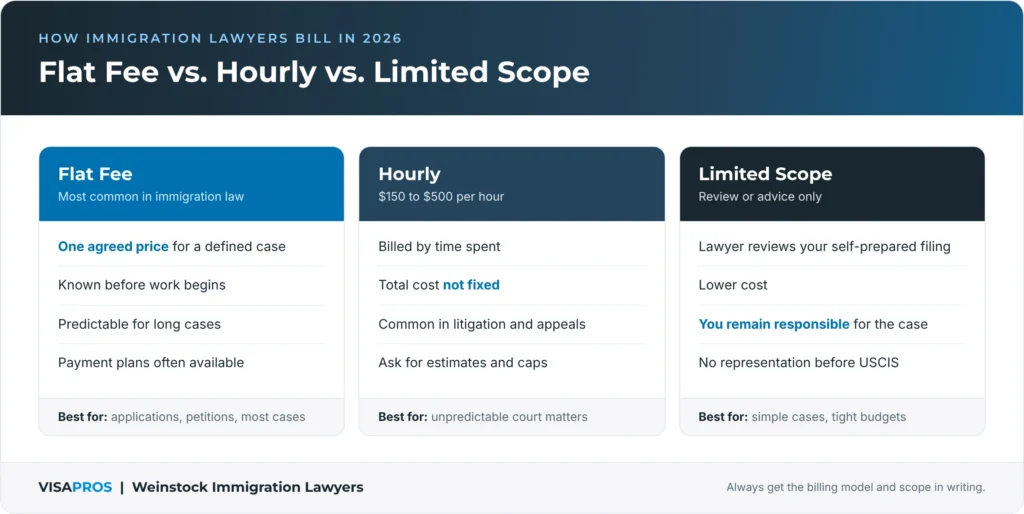
Flat fees dominate for a reason: immigration cases run for months or years, and families need to budget. A flat fee also aligns incentives, because the firm profits from efficiency rather than from accumulating billable hours. When comparing firms, always ask whether a quote is flat or hourly, and what happens to the price if the government issues a Request for Evidence or schedules a second interview.
Many firms also offer payment plans that spread a flat fee over the months when a case is pending. If cash flow is the obstacle, ask; it is a routine request.
What a Flat Fee Should Include (and What Costs Extra)
A well-drafted flat fee agreement should spell out exactly what is covered. For a typical application case, that should include case strategy and eligibility analysis, preparation of all forms in the covered filing, review and organization of your supporting evidence, attorney review before filing, responses to routine government correspondence, and preparation for the interview.
Commonly excluded, and worth asking about up front: government filing fees, translations, medical exams, courier costs, RFE responses (some firms include them, some bill separately), motions or appeals after a denial, and any new filing types that become necessary mid-case. None of these exclusions are dishonest, but you should know about them before signing, not after.
Attorney Fees vs. Government Filing Fees
Attorney fees and government filing fees are two separate costs, and quotes that blur them are a warning sign. Government fees go to USCIS or the Department of State no matter who prepares for your case.
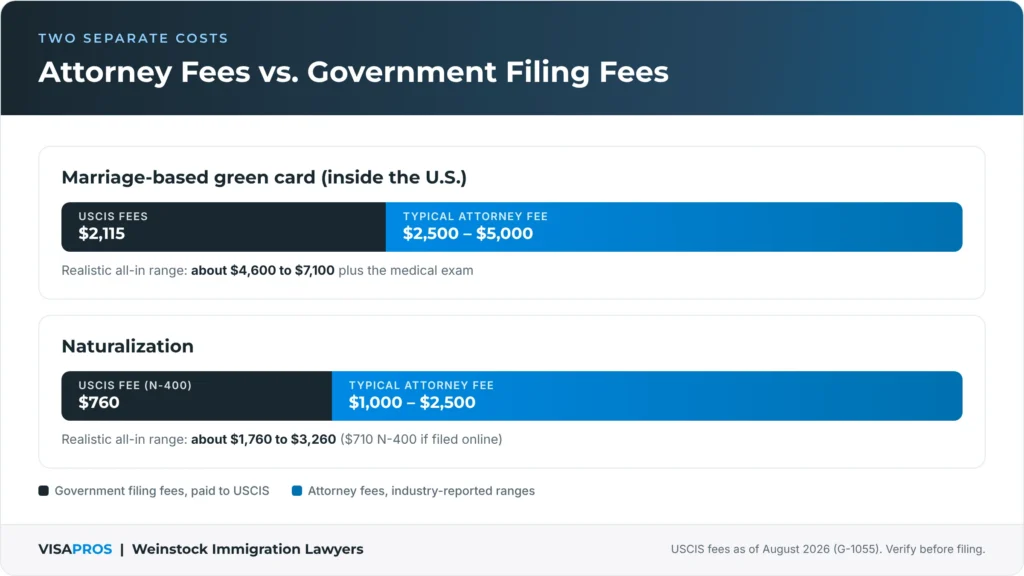
Two examples using current USCIS fees as of August 2026:
- Marriage-based green card (inside the U.S.): $2,115 in required USCIS fees (I-130 + I-485), plus a typical attorney fee of $2,500 to $5,000, for a realistic all-in range of roughly $4,600 to $7,100 before the medical exam
- Naturalization: $760 for the paper N-400 ($710 online), plus a typical attorney fee of $1,000 to $2,500
Always confirm current government fees on the USCIS Fee Schedule (G-1055), since they change periodically. A trustworthy firm will itemize the two categories in writing.
Who Pays the Fees in Employment Cases?
If an employer is sponsoring you for a work visa or green card, much of the cost is legally the employer’s bear. Department of Labor rules require the employer to pay all costs of the PERM labor certification, including attorney fees and recruitment costs; those costs cannot be passed to the employee. For H-1B petitions, the employer must pay the required filing and fraud-prevention fees and cannot recoup them from the worker’s wages were doing so would cut pay below the required wage.
Employees typically pay their own costs for optional or personal items, such as dependent family filings or, in many companies, at the final I-485 stage. If a prospective employer asks you to reimburse PERM or required H-1B costs, that is a compliance problem, and worth a conversation with an attorney.
Free and Low-Cost Immigration Legal Help
A private lawyer is not the only option, and for some situations a free one exists:
- Nonprofit legal aid organizations serve low-income immigrants in most states, often with sliding-scale fees
- DOJ-accredited representatives at recognized organizations can lawfully represent you in many immigrations matters at low cost
- The EOIR pro bono list (maintained by the Department of Justice) names free legal service providers for people in immigration court proceedings
- Fee waivers: USCIS waives certain filing fees (Form I-912) for applicants who receive means-tested benefits or demonstrate financial hardship. A fee waiver reduces government costs, not attorney fees
- Law school clinics and bar association referral programs in many cities
Demand far exceeds supply for free help, and waiting lists are common. For time-sensitive cases, weigh the cost of waiting against the cost of paid counsel.
Red Flags: Overpriced Quotes, Hidden Fees, and Notario Fraud
The most expensive immigration “lawyer” is the one who wrecks your case. Watch for these warning signs:
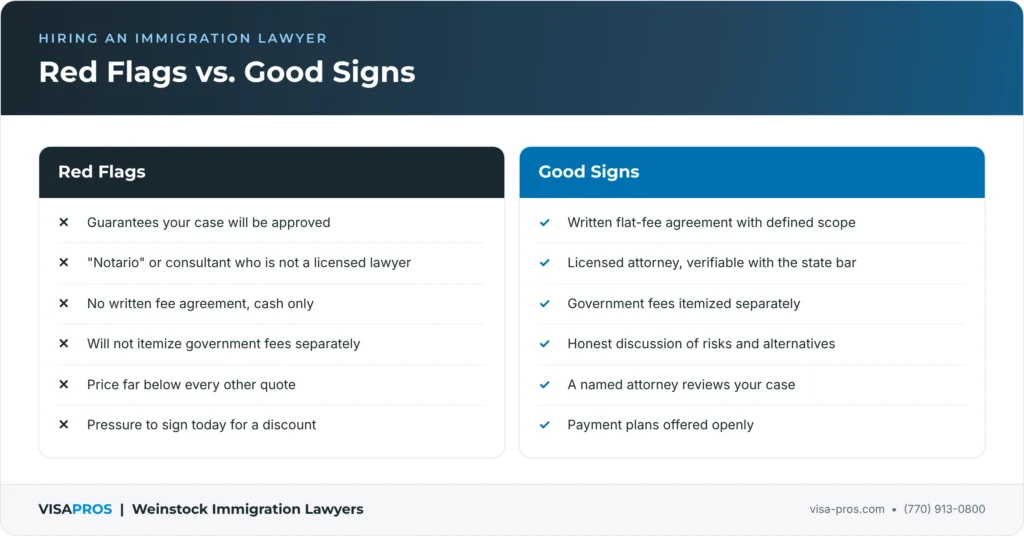
Red flags:
- Guaranteed approval. No lawyer controls USCIS or a judge. Guarantees signal dishonesty, not confidence
- “Notarios” and immigration consultants. In the U.S., a notary public is not a lawyer and cannot give legal advice. Notario fraud ruins cases and, in the worst outcomes, triggers removal proceedings. Only licensed attorneys and DOJ-accredited representatives may lawfully represent you
- No written fee agreement, cash-only demands, or refusal to itemize what is included
- Prices are dramatically below the market. A $500 green card case is usually a form-filling service with no legal analysis, and errors surface at the interview or years later
- Pressure tactics and same-day signing discounts
Good signs: a written flat-fee agreement with defined scope, itemized government fees, verifiable bar membership, AILA membership, a named attorney who reviews your case, and realistic talk about risks.
You can verify any attorney’s license through their state bar, and check discipline history. Five minutes of verification beats years of cleanup.
Is Hiring an Immigration Lawyer Worth It?
For simple cases with clean histories, some people file successfully on their own, and an honest lawyer will tell you so at a consultation. Representation earns its cost when the stakes or the complexity rise:
- Any criminal record, prior denial, overstay, unlawful entry, or misrepresentation issue
- Removal proceedings, where represented immigrants have historically fared far better than unrepresented ones
- Employer cases, where regulatory missteps in PERM or H-1B filings carry company-wide consequences
- Cases where a single mistake costs a year: a rejected filing, a botched RFE response, or a missed deadline can exceed the price of representation in lost time alone, especially with 2026’s heightened scrutiny and near-universal interviews
The right frame is not “lawyer vs. no lawyer” but “what does an error cost in this case.” When the answer is a denial, a bar to reentry, or a family separated for an extra year, professional preparation is cheap insurance.
How Visa Pros Prices Immigration Cases
Visa Pros (Weinstock Immigration Lawyers) bills on a flat-fee basis for immigration services, with payment plans available. You know the full attorney fee before we begin; government fees are itemized separately, and the price does not grow because a case takes longer than expected. We also offer a free case evaluation, so finding out what your specific case would cost requires nothing more than a call.
Our team has handled thousands of cases across family, employment, citizenship, and deportation defense matters for clients in Georgia, Alabama, and nationwide. That experience is what a fee actually buys: knowing what USCIS will question before it asks.
Next Steps
Ballpark ranges tell you whether a quote is reasonable. They cannot tell you what your case costs, because that depends on facts a lawyer needs to hear first: your history, your goal, and your deadlines.
If you want a real number instead of a range, contact Visa Pros for a free case evaluation at our Georgia or Alabama offices, or virtually from anywhere in the U.S. You will leave with a flat-fee quote in writing and a clear picture of what your case involves.
This article provides general information and industry-reported fee estimates, not legal advice or a quotation. Attorney fees vary by case; government fees change periodically and should be verified with USCIS. Consult with a licensed immigration attorney about your specific circumstances.
Frequently Asked Questions
Typical flat fees range from about $1,000 to $2,500 for naturalization, $2,500 to $5,000 for a family-based green card, $4,000 to $10,000 for asylum, and $4,000 to $15,000 or more for deportation defense, based on industry-reported national ranges. Government filing fees are separate.
Consultations typically range from free to about $300. Many firms offer a free case evaluation, and firms that charge often credit the consultation fee toward your case if you hire them.
A flat fee is one agreed price for a defined case; paid regardless of how many hours the work takes. It is the most common billing model in immigration law because it lets family’s budget for cases that run months or years. Always confirm in writing what the flat fee covers.
Many do, including Visa Pros. Payment plans typically spread a flat fee over the months a case is pending. Ask about payment options at the consultation; it is a routine request.
Typical attorney fees for a marriage-based green card run about $2,500 to $5,000 in 2026. With the $2,115 in required USCIS filing fees, a realistic all-in budget is roughly $4,600 to $7,100 plus the medical exam.
No. Government fees go to USCIS or the Department of State regardless of who prepares your case, and reputable firms itemize them separately. For example, the I-485 green card application fee is $1,440 and the paper N-400 naturalization fee is $760 as of August 2026.
The employer, in most respects. Department of Labor rules require employers to pay all PERM labor certification costs including attorney fees, and employers must pay the required H-1B filing fees. These costs cannot be shifted to the employee.
Sometimes. Nonprofit legal aid organizations, DOJ-accredited representatives, law school clinics, and the EOIR pro bono list for immigration court cases all provide free or low-cost help. Demand is high and waiting lists are common, so start early.
For clean, simple cases, some people succeed on their own. Representation is most valuable when there is any criminal or immigration history, a prior denial, removal proceedings, an employer compliance obligation, or a situation where a single error costs a year or a denial. With 2026’s heightened vetting and near-universal interviews, professionally prepared cases carry less risk.
Because scope and complexity vary. One quote may cover only form of preparation while another includes strategy, evidence development, RFE responses, and interview preparation. Complications like prior denials or criminal records also move price. Compare what is included, not just the number.
At minimum: eligibility analysis and strategy, preparation of all covered forms, evidence review, attorney review before filing, routine government correspondence, and interview preparation. Ask specifically whether RFE responses are included and what happens to the price if the case becomes more complex.
Ready to Resolve Your Immigration Issue?
Whether it’s a work visa, green card, citizenship, or deportation defense, our Atlanta immigration attorneys are ready to help you find the best path forward.