

Quick Answer
PERM labor certification takes roughly 12 to 14 months of Department of Labor review after filing in 2026, with DOL reporting average analyst review times of about 372 to 403 days in recent months. Adding the prevailing wage determination (about 5 to 8 months) and recruitment (2 to 4 months), the full PERM process typically runs 20 to 26 months from start to certification. An audit adds roughly 9 or more months. There is no premium processing for PERM.
Summary
- What it is: The DOL labor certification most EB-2 and EB-3 employment green cards require before the employer can file Form I-140
- Current analyst review: DOL reported averages of roughly 372 to 403 days in mid-2026, reviewing applications filed around September 2025
- Prevailing wage determination: about 5 to 8 months for most OEWS-based requests
- Audits: add roughly 9 or more months; a meaningful share of cases is audited, including random selections
- No filing fee and no premium processing for PERM itself
- After approval: the certification is valid for 180 days, within which the employer must file Form I-140
Introduction
If you are waiting on a PERM case in 2026, the honest news is that the Department of Labor is slower than it has been at almost any point in the program’s history. Employers now plan around a multi-year runway for employment-based green cards, and foreign workers on H-1B visas need to think carefully about timing long before the six-year limit approaches.
This guide breaks down where PERM processing times actually stand in 2026, what each stage involves, what triggers audits, and what employers and employees can do about delays.
What Is PERM Labor Certification?
PERM (Program Electronic Review Management) is the Department of Labor’s labor certification process that most employment-based green cards require as a first step. Before an employer can sponsor a worker for an EB-2 or EB-3 green card, PERM requires the employer to test the U.S. labor market and prove that no able, willing, qualified, and available U.S. worker applied for the position at the offered wage. The employer files ETA Form 9089 through the DOL’s FLAG system, and a certified PERM application is the foundation for the Form I-140 immigrant petition filed with USCIS.
PERM is employer-driven: the company, not the employee, is the applicant, and the company must pay the recruitment and legal costs of the labor certification stage.
How Long Does PERM Take in 2026?
DOL analyst review of a filed PERM application currently averages roughly 12 to 14 months. In its mid-2026 updates, the department reported average processing of about 372 to 403 days and was working on applications filed around September 2025. Audited cases wait significantly longer, with audit review adding roughly 9 or more months on top of the standard queue.
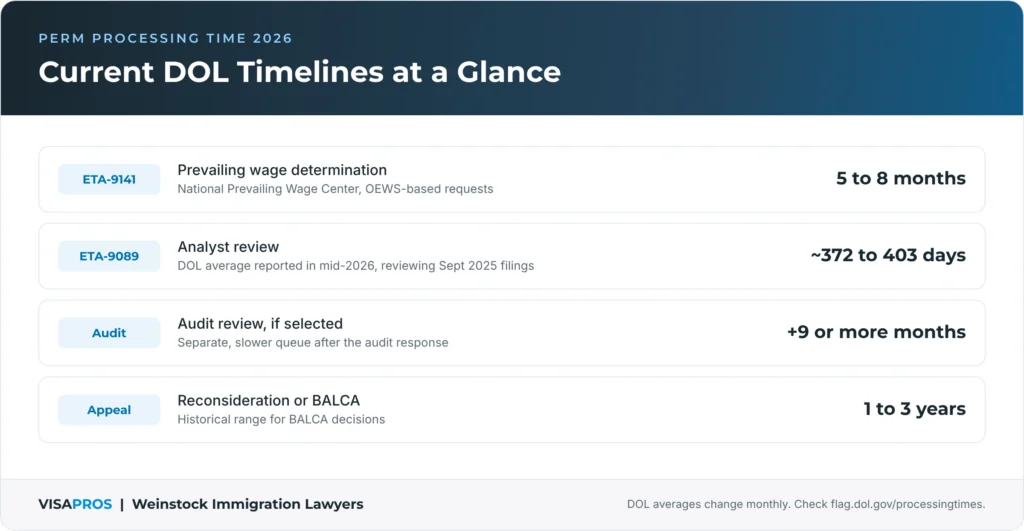
In text form, the current DOL picture looks like this: prevailing wage determinations are taking about 5 to 8 months for most OEWS-based requests. Analyst reviews of the ETA-9089 averaged roughly 372 to 403 days per DOL’s mid-2026 reports. Cases pulled for audit wait roughly 9 or more additional months in the audit queue. Denied cases pursuing reconsideration or a BALCA appeal can wait a year or more, with BALCA decisions historically taking 1 to 3 years.
Two caveats matter. First, DOL updates its published average monthly at flag.dol.gov, and figures move; always check the current numbers. Second, the published number is average, not guaranteed. Individual cases finish faster or slower depending on the queue, the occupation, and whether an audit hits.
PERM Timeline Stage by Stage
The full PERM process typically takes 20 to 26 months from starting the prevailing wage request to certification in 2026, assuming no audit. Here is how that breaks down.
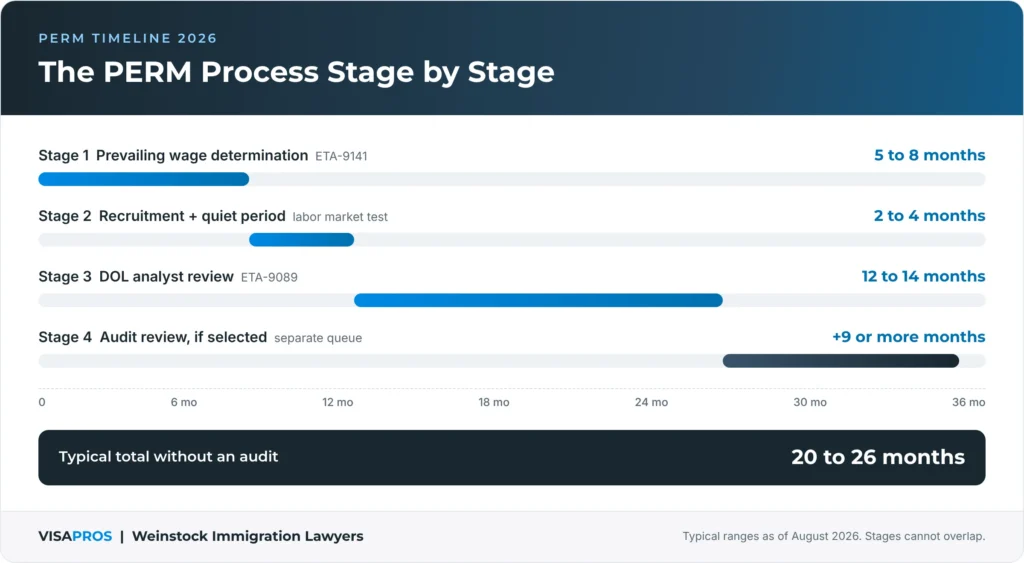
Stage 1: Prevailing wage determination (about 5 to 8 months)
The employer files Form ETA-9141 with the National Prevailing Wage Center to establish the minimum salary for the position, based on the job duties, requirements, and location. Most requests rely on OEWS government wage data. Nothing else in the case can be finalized until the NPWC issues the determination, which makes this quiet stage one of the biggest hidden contributors to total PERM time.
Stage 2: Recruitment and the quiet period (about 2 to 4 months)
The employer runs a prescribed labor market test: a job order with the state workforce agency, two Sunday newspaper ads (or permitted alternatives), additional recruitment steps for professional positions, and an internal notice of filing. Recruitment must be completed within a defined window: ads must run more than 30 days but less than 180 days before filing. The mandatory 30-day quiet period after recruitment ends allows late applicants to come forward before the employer signs off that no qualified U.S. worker applied.
Stage 3: Filing and analyst review (roughly 12 to 14 months in 2026)
The employer files ETA Form 9089 in the FLAG system. There is no DOL filing fee. The case then sits in the analyst’s review queue, where a DOL analyst checks the application for completeness, compliance, and red flags. Most cases are certified at this stage without further requests. This queue is where the widely quoted “PERM processing time” figure applies, and in 2026 it stands at roughly a year or more.
Stage 4: Audit, if selected (adds roughly 9 or more months)
If the certifying officer selects the case for audit, the employer must submit the complete recruitment file and supporting documentation. The case then moves to a separate, slower audit queue. Audits are discussed in detail below.
What Triggers a PERM Audit?
DOL audits a meaningful share of PERM applications every year. Some audits are purely random, so even a flawless application can be selected. Others are targeted, and practitioners consistently see the same triggers.
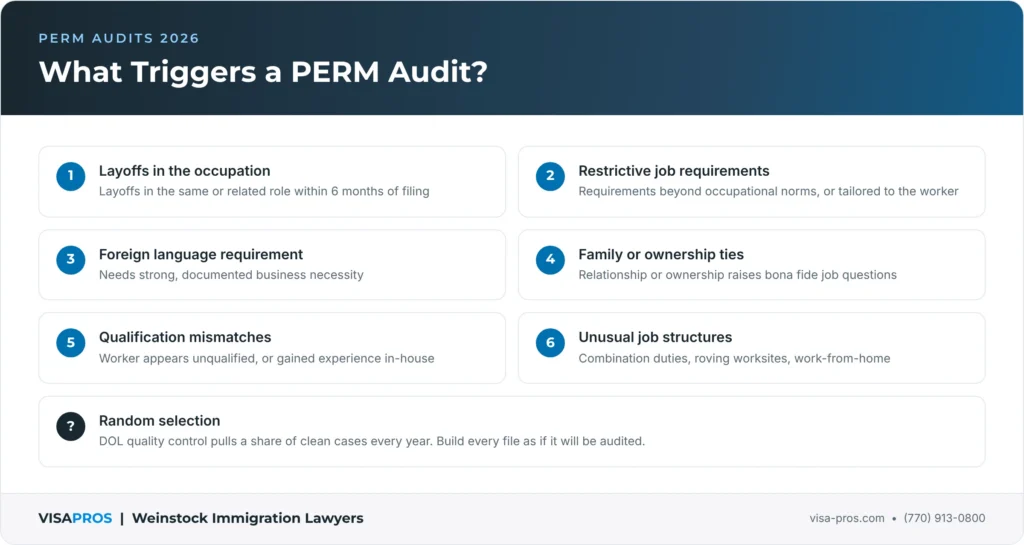
The most common audit triggers include:
- Layoffs. The employer had layoffs in the same or a related occupation within six months of filing, which requires documented consideration of those laid-off U.S. workers.
- Restrictive job requirements. Requirements that exceed what is normal for the occupation, or that appear tailored to the sponsored worker’s exact background, invite scrutiny under the business necessity standard.
- Foreign language requirements. Requiring a language other than English is a classic trigger and demands strong business necessity documentation.
- Family or ownership ties. A familial relationship between the worker and the employer, or the worker holding an ownership interest, raises questions about whether a genuine job opportunity exists.
- Qualification mismatches. The sponsored worker appears to lack the stated requirements or gain the required experience with the same employer in a substantially similar role.
- Combination of occupations and unusual job structures, such as roving employees or work-from-home arrangements that complicate the prevailing wage and recruitment analysis.
- Random selection. No trigger at all. DOL’s quality control program pulls out a share of clean cases every year.
The practical lesson: employers should build every PERM file as if it will be audited, because a meaningful percentage will be, and the file cannot be fixed after filing.
What Happens During a PERM Audit?
An audit notification gives the employer 30 days to submit the complete audit file: recruitment documentation, the recruitment report, resumes of U.S. applicants with lawful reasons for rejection, prevailing wage documentation, and any business necessity justifications. The deadline is strict and failing to respond results in denial and can trigger supervised recruitment in future filings.
After the response, the case waits in the audit review queue, which is adding roughly 9 or more months in 2026. Three outcomes are possible: certification, denial, or an order of supervised recruitment, where DOL directs and pre-approves a new recruitment effort. Supervised recruitment typically adds six months or more and substantially increases cost, which is why audit responses deserve attorney-level care.
Why Is PERM Taking So Long?
Several forces are stacking up in 2026:
- Filing volume. Employment of green card demand remains high, and DOL staffing has not kept pace with the queue.
- Sequential structure. PERM stages cannot overlap. The prevailing wage request must finish before recruitment can conclude, and recruitment must finish before filing. Every stage delay compounds the next.
- Audit rates and quality control. More cases are routed to the audit queue to slow both the audited cases and overall throughput.
- No premium processing. Unlike many USCIS filings, PERM has no paid expedite option. The queue is in the queue.
Can You Speed Up PERM?
No. There is no premium processing or paid expedite for PERM, and DOL grants expedited treatment only in rare, documented circumstances. What employers can control is avoiding self-inflicted delays:
- File the prevailing wage request as early as possible; it is the longest lead item an employer fully controls the start of.
- Run recruitment precisely by the rules. Defective recruitment cannot be repaired after filing and is the fastest route to denial or refiling.
- Draft job requirements that match the occupation norms, with business necessity documentation prepared in advance for anything unusual.
- Keep the audit file complete and organized from day one, so a 30-day audit deadline is a formality rather than a crisis.
- Track the case against DOL’s published averages and calendar in the recruitment validity window (ads expire 180 days after they run), so the case never has to restart recruitment.
PERM Delays and the H-1B Six-Year Limit
For H-1B employees, PERM timing is not just an inconvenience. It determines whether they can stay in the United States past the six-year H-1B limit. Under AC21, an H-1B worker can extend status beyond six years if a PERM application or I-140 petition was filed at least 365 days before the six-year limit is reached, or in three-year increments once an I-140 is approved but a green card number is unavailable.
With PERM alone consuming roughly two years in 2026, the practical rule of thumb is to start the prevailing wage request no later than the beginning of the H-1B’s fourth year, and earlier for workers born in countries with long visa backlogs. Waiting until year five leaves no margin for an audit, a denial, or an ordinary DOL slowdown.
After PERM Approval: I-140, Priority Dates, and the 180-Day Deadline
A certified PERM is valid for 180 days. The employer must file Form I-140 with USCIS within that window, or the certification expires, and the entire process starts over. The I-140 filing fee is $715, and premium processing is available for the I-140 stage ($2,805 for a 15-business-day decision), which is often worth it after waiting years for PERM.
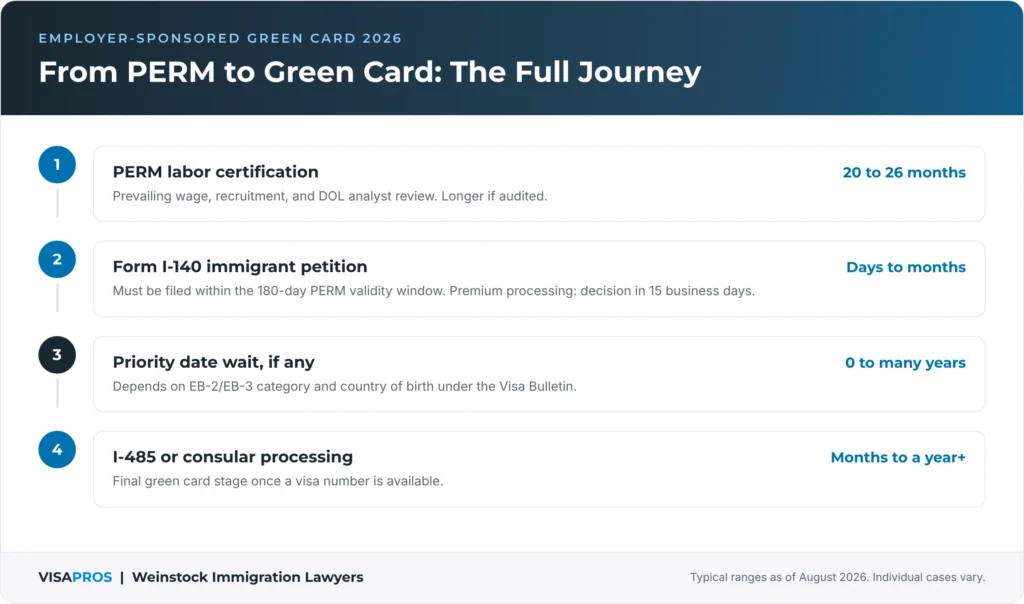
The worker’s priority date is the date the PERM application was filed with DOL, which determines their place in the visa queue. Workers from countries with heavy demand, particularly India and China, may wait years beyond PERM and I-140 approval before a green card number becomes available under the Department of State Visa Bulletin. Workers from most other countries can often move to the final I-485 adjustment status stage much sooner.
End to end, an employer-sponsored green card in 2026 typically means: roughly 20 to 26 months for PERM, days to months for the I-140 depending on premium processing, and a final stage that ranges from under a year to many years depending on the worker’s category and country of birth.
If PERM Is Denied: Reconsideration, BALCA, and Refiling
Dental is not necessarily the end. The employer has 30 days to request reconsideration by the certifying officer or review by the Board of Alien Labor Certification Appeals (BALCA). Reconsideration can succeed where the denial rests on a factual or clerical error, but BALCA appeals historically take 1 to 3 years, which often makes them impractical.
In many cases, the faster path is refiling a corrected application, provided the recruitment is still valid or can be redone. The right choice depends on why the case was denied, how the recruitment clock stands, and the employee’s status timeline. This is a decision point where experienced counsel pays for itself.
When Employers Should Involve an Immigration Attorney
PERM is unforgiving by design: the regulations are technical, the deadlines are strict, and errors generally cannot be corrected after filing. Attorney involvement matters most when:
- The role has any nonstandard feature: unusual requirements, a foreign language, telecommuting, a combination of duties, or experience gained in-house
- The company has had layoffs within six months in related roles
- An audit notification or supervised recruitment order arrives
- A denial forces a choice among reconsideration, BALCA, and refiling
- The employee’s H-1B six-year limit or a visa backlog makes timing strategy critical
- A case has sat far beyond DOL’s published averages, where escalation options, including federal delay litigation in extreme cases, deserve evaluation
At Visa Pros (Weinstock Immigration Lawyers), our attorneys have managed PERM labor certifications for employers in Georgia, Alabama, and nationwide for decades, from prevailing wage strategy through audits, appeals, and the I-140 and I-485 stages that follow. If you are planning a filing or watching a case stall, a consultation early in the process protects both the company and the employee’s timeline.
Next Steps
PERM processing time in 2026 rewards employers who start early, recruit precisely, and build every file to audit standards. The DOL queue itself cannot be rushed, but almost every other source of delay is avoidable with planning.
If your company is preparing a PERM filing, facing an audit, or trying to protect an employee’s H-1B timeline against a slow case, the employment immigration attorneys at Visa Pros can map the fastest compliant path. Contact us for a consultation at our Georgia or Alabama offices, or virtually from anywhere in the U.S.
This article provides general information about U.S. immigration law and is not legal advice. Processing times and policies change frequently; verify current figures with the Department of Labor and USCIS or consult a qualified immigration attorney about your specific circumstances.
Frequently Asked Questions
DOL analyst review currently averages roughly 12 to 14 months after filing, based on reported averages of about 372 to 403 days in mid-2026. Including the prevailing wage determination and recruitment, the full PERM process typically takes 20 to 26 months, and an audit adds roughly 9 or more months.
PERM is the Department of Labor labor certification required for most EB-2 and EB-3 employment-based green cards. The employer must test the U.S. labor market and certify that no able, willing, qualified, and available U.S. worker applied for the position before filing the Form I-140 immigrant petition with USCIS.
The published DOL figure is average, not maximum. Cases selected for audit join a separate queue that adds roughly 9 or more months, and complex occupations or quality control review can also slow individual cases. If your case is far beyond the average for its filing month, an attorney can evaluate status inquiries and escalation options.
Common triggers include recent layoffs in the occupation, job requirements that exceed occupational norms or appear tailored to the foreign worker, foreign language requirements, family or ownership ties between the worker and employer, and experience gained with the sponsoring employer. A share of audits is random, so clean cases are selected too.
Audited cases wait roughly 9 or more additional months beyond the standard analyst review queue in 2026. The employer has 30 days to submit the audit response; the long wait comes after, in DOL’s audit review queue.
No. There is no premium processing for PERM and no paid way to move up the DOL queue. The best available strategy is starting early, especially the prevailing wage request, and avoiding errors that force refiling.
Most Form ETA-9141 requests are taking about 5 to 8 months at the National Prevailing Wage Center, with standard OEWS-based requests toward the longer end at times. DOL posts current figures at flag.dol.gov.
The employer must file Form I-140 with USCIS within 180 days, or the labor certification expires. The I-140 fee is $715, and premium processing ($2,805) is available for a decision within 15 business days. The worker’s priority date, set by the PERM filing date, then governs when the final green card stage can begin.
No. The employer can request reconsideration or BALCA review within 30 days, or refile a corrected application. Because BALCA appeals historically take 1 to 3 years, refiling is often the faster route when the recruitment can be redone.
An H-1B worker can extend status beyond the six-year limit only if a PERM or I-140 was filed at least 365 days earlier, or once an I-140 is approved. With PERM taking roughly two years in 2026, employers should generally start the process by the beginning of the H-1B’s fourth year.
No. DOL charges no fee to file ETA Form 9089. The employer bears the recruitment costs and legal fees of the PERM stage, and by regulation the employer, not the employee, must pay the costs of the labor certification.
Ready to Resolve Your Immigration Issue?
Whether it’s a work visa, green card, citizenship, or deportation defense, our Atlanta immigration attorneys are ready to help you find the best path forward.