

Introduction
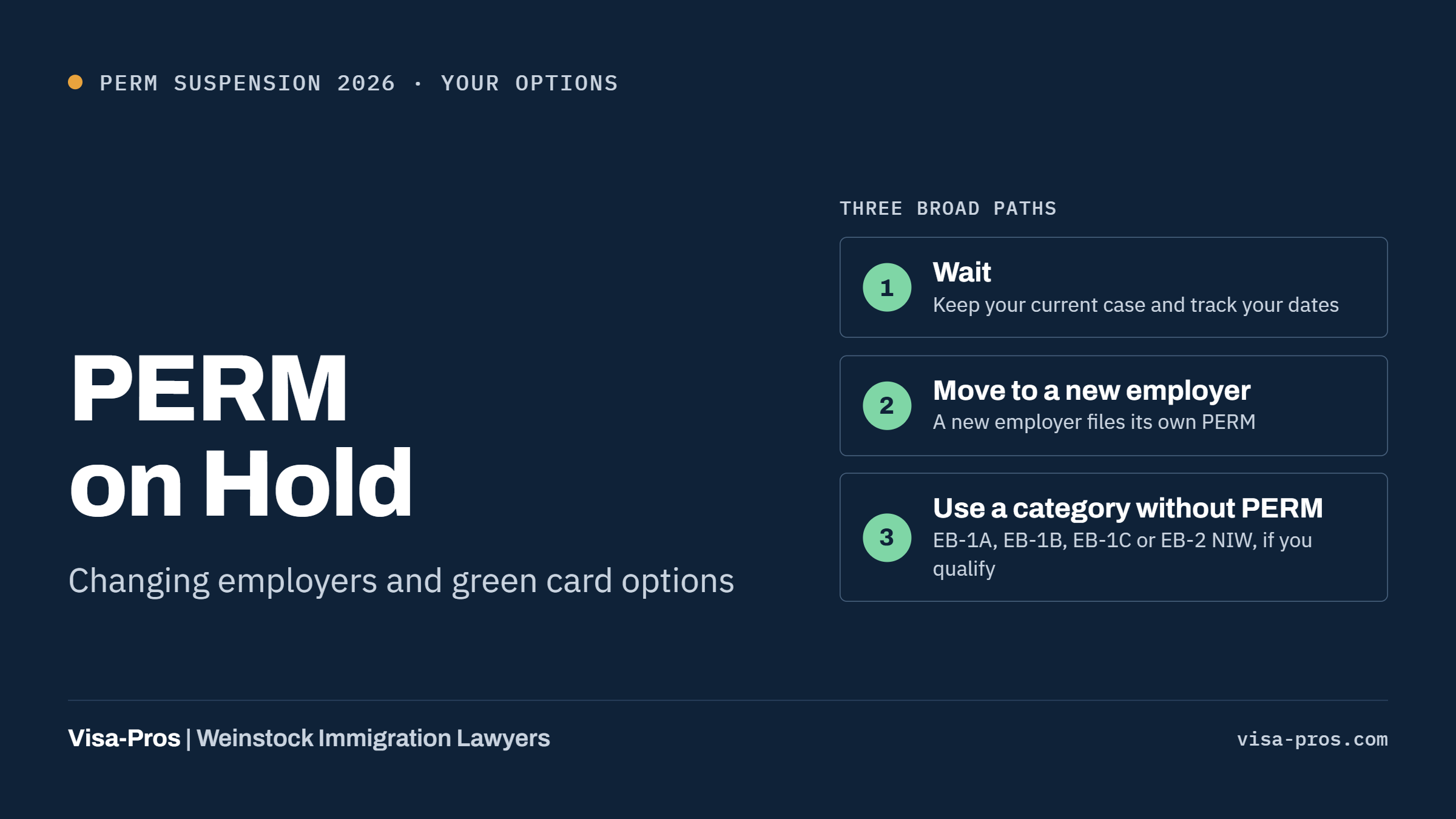
Within hours of the October 8 announcement, immigration lawyers were being asked the same question by employees of all eight suspended companies: should I leave?
The early answers were careful. Reddy Neumann Brown, a Houston firm with a large Indian technology clientele, wrote that changing employers may be the more prudent strategy in some cases and also that employees should not make major career decisions based solely on headlines. Both statements are true, and the gap between them is where each worker’s own facts come in. A worker with an approved I-140 and a 2015 priority date faces a different decision from a worker in year five with nothing filed.
This piece explains what carries over when you change employers, what you would have to restart and which categories avoid PERM altogether. The announcement itself is covered in our main report on the PERM suspension.
What a New Employer Has to Redo
A PERM is tied to one employer and one position. A new employer starts from the beginning with a new prevailing wage determination, new recruitment, a new PERM and a new I-140.
The suspension covers applications involving the eight named companies, so an employer outside that list can file its own PERM. The cost is time. Our guide to PERM processing time sets out current timelines, and the new case has to be far enough along to support H-1B extensions before your six years run out. That calculation is explained in H-1B Extension After 6 Years When PERM Is Suspended.
What You Keep
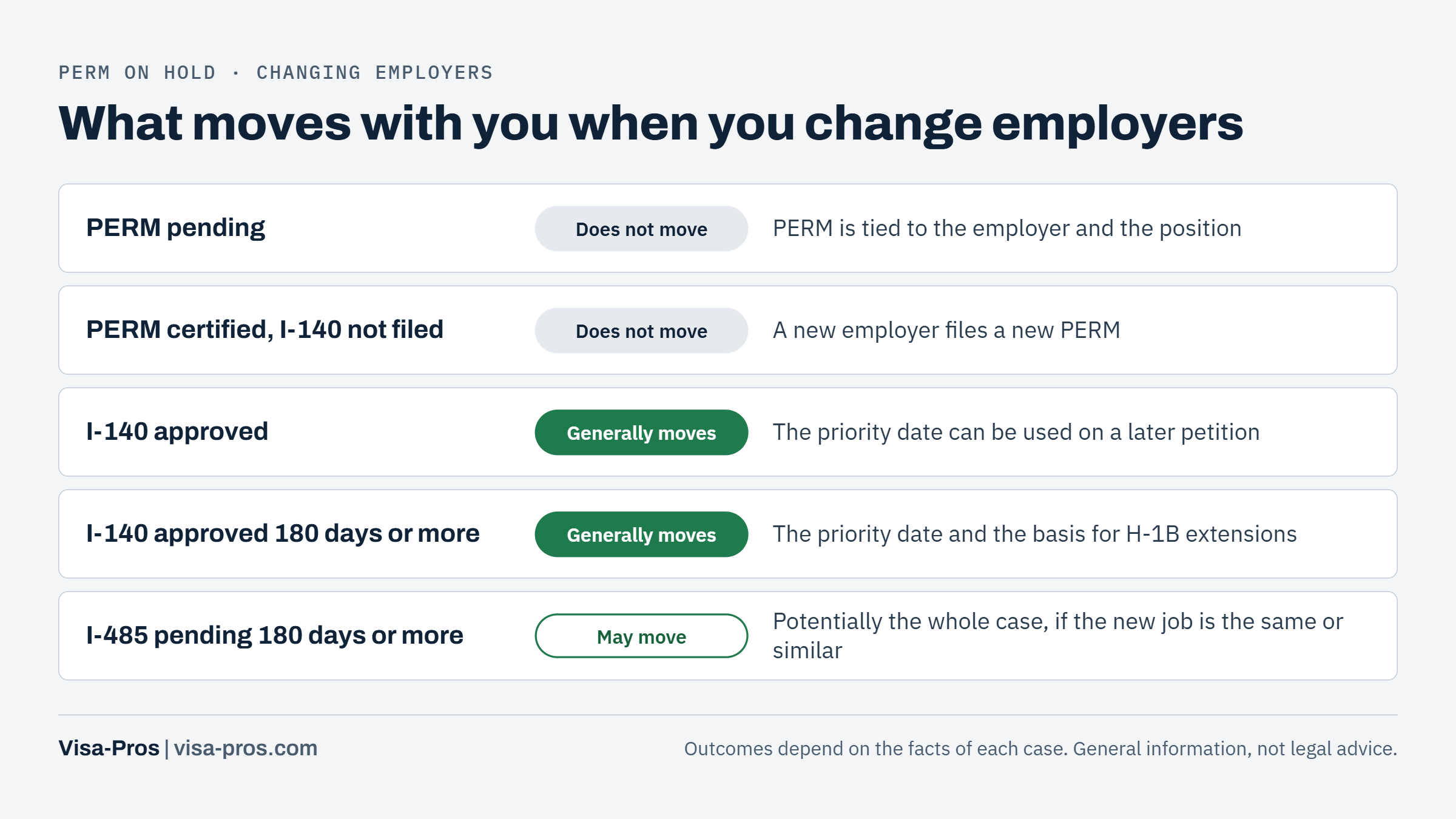
| Your stage | Does it move with you? |
|---|---|
| PERM pending | No |
| PERM certified, no I-140 filed | No |
| I-140 approved | The priority date generally does |
| I-140 approved 180 days or more | The priority date and the basis for H-1B extensions |
| I-485 pending 180 days or more | Potentially the whole case, if the new job qualifies |
The priority date is the asset that matters. Under 8 CFR 204.5(e) a worker with an approved I-140 can generally carry that date to a later petition, which means restarting the paperwork without returning to the back of the line. An I-140 that has been approved for at least 180 days usually keeps its priority date even if the employer later withdraws it. The date can be lost if the approval is revoked for fraud, for a material USCIS error or after the underlying labor certification is revoked or invalidated. None of those has been announced.
If Your I-485 Has Been Pending 180 Days
Under the normal portability rules a worker may be able to change employers after an I-485 has been pending 180 days if the new position is in the same or a similar occupational classification, and the announcement does not eliminate those rules.
The new job offer is documented on Form I-485 Supplement J under 8 CFR 245.25, and the underlying I-140 must be approved or be approved later. The comparison between the old role and the new one is where these cases succeed or fail, so it deserves a careful review before an offer is accepted.
Routes That Skip PERM
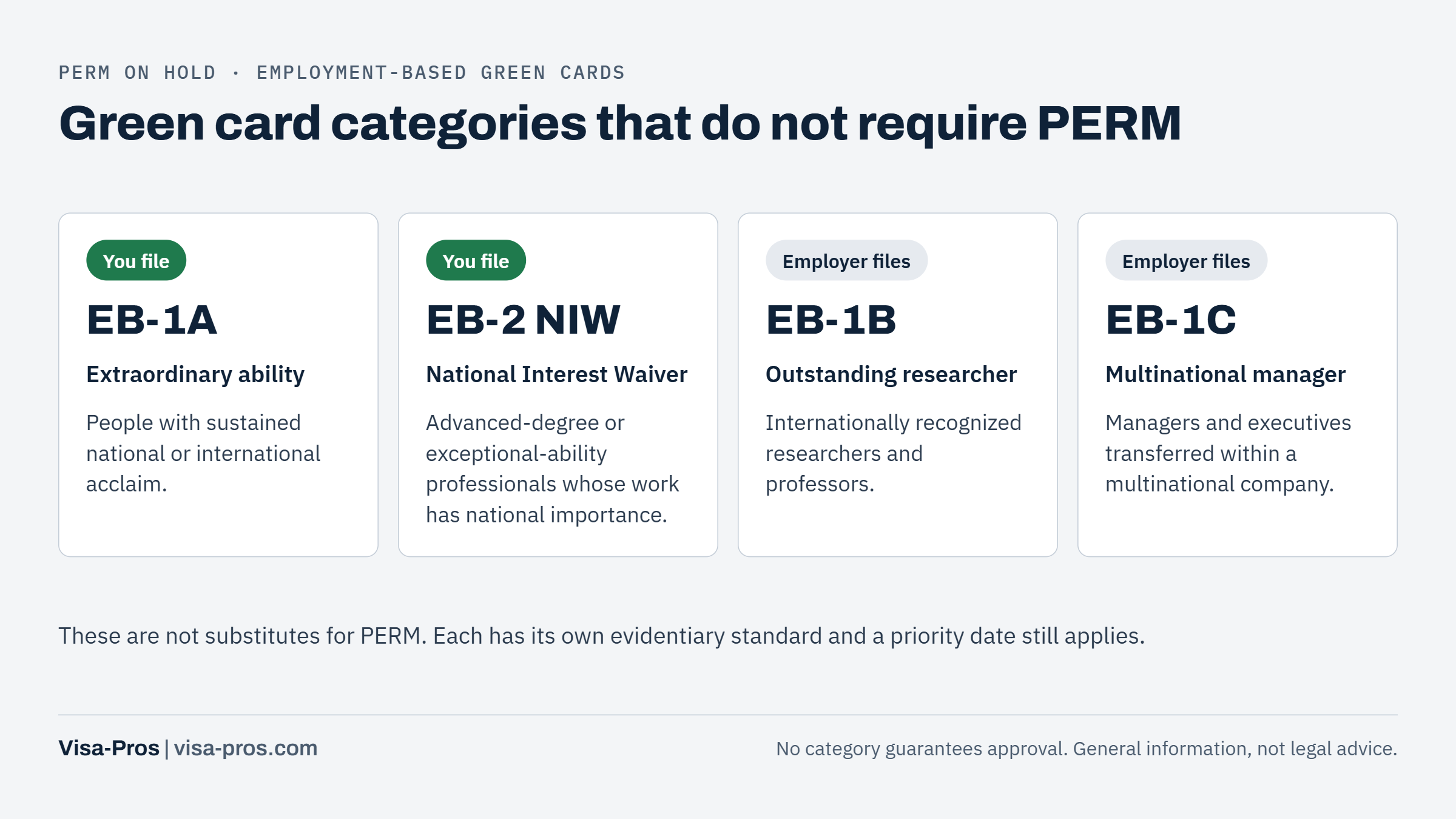
| Category | Who files | Who it may fit |
|---|---|---|
| EB-1A extraordinary ability | You | People with sustained national or international acclaim |
| EB-2 National Interest Waiver | You | Advanced-degree or exceptional-ability professionals whose work has national importance |
| EB-1B outstanding researcher | Employer | Internationally recognized researchers and professors |
| EB-1C multinational manager | Employer | Managers and executives transferred within a multinational company |
Interest in these categories will rise sharply this month, and some caution is in order. They are not substitutes for PERM. Each carries a different and often higher evidentiary standard, and many strong professionals do not qualify. A priority date still applies, so visa availability continues to depend on category and country of birth. EB-1B and EB-1C also need an employer willing to file. The October 8 announcement concerned PERM and did not address those petitions.
We cover the two self-petitions in EB2 NIW vs EB1A and EB-2 NIW in 2026. The full list is in employment-based green card categories.
Four Situations
Year four on H-1B with nothing filed. There is time. A new employer’s PERM or a self-petition could each start the clock, and the comparison is how long each would take against your six-year date.
PERM pending for 14 months. The filing is more than 365 days old and may support one-year H-1B extensions while frozen. Leaving means giving that filing up.
I-140 approved with a priority date years from current. The date generally stays with you. A move costs paperwork and time. It does not cost your place in line.
I-485 pending for 200 days. Portability may allow a move without a new PERM if the new role is the same or similar.
These are illustrations and your facts may lead somewhere different.
Questions to Settle Before You Decide
- What is my six-year H-1B date after recapture?
- Is my I-140 approved and for how long?
- How far is my priority date from current?
- Will the new employer start PERM immediately and confirm that in writing?
- Is the new role the same or similar to my sponsored role?
- Do I have a realistic case for a self-petition?
Weighing a move or a self-petition? Visa-Pros can assess your options before you commit. Request a consultation.
A Note on Visa-Pros
Visa-Pros is the immigration practice of Weinstock Immigration Lawyers, a Georgia and Alabama firm led by Managing Attorney Karen Weinstock. The team files PERM cases for employers and prepares EB-1 and EB-2 NIW petitions for individuals. An honest assessment includes telling you when a category is not a fit. You can schedule a consultation or call (770) 913-0800.
Sources: 8 CFR 204.5, 8 CFR 245.25, Reddy Neumann Brown, Ellis, i9 Intelligence
Frequently Asked Questions
Ready to Resolve Your Immigration Issue?
Whether it’s a work visa, green card, citizenship, or deportation defense, our Atlanta immigration attorneys are ready to help you find the best path forward.